Skip to main content Skip to footer

PsyD Outcomes & Professional Preparation

Learn about educational outcomes and training framework of the Doctor of School/Clinical Psychology (PsyD) program.

This page covers:

  • program aims
  • discipline-specific knowledge areas
  • profession-wide competencies
  • research and dissertation requirements
  • clinical practicum and internship training
  • student outcome data

Together, these components reflect the program’s commitment to preparing ethical, evidence-based practitioners for professional practice in clinical and school psychology.

Program Aims

Program Aim One

To prepare doctoral level practitioners of health service psychology who can ethically deliver effective, evidence-based psychological services in a variety of settings with diverse populations.

  • The program is designed to ensure that students have attained the necessary discipline-specific knowledge that provides a foundation for the practice health service psychology, including graduate level knowledge of:
    • History and Systems of Psychology
    • Affective Aspects of Behavior
    • Biological Aspects of Behavior
    • Cognitive Aspects of Behavior
    • Developmental Aspects of Behavior
    • Social Aspects of Behavior
    • Advanced Integrative Knowledge of Basic Discipline-Specific Content Areas
    • Research Methods
    • Quantitative Methods
    • Psychometrics
  • The program is designed to ensure that students have attained the necessary profession-wide competencies for the practice of health service psychology, including competencies in:
    • Research
    • Ethical and legal standards
    • Individual and cultural diversity
    • Professional values and attitudes
    • Communication and interpersonal skills
    • Assessment
    • Intervention
    • Supervision
    • Consultation and interprofessional/interdisciplinary skills

Program Aim Two

To prepare practitioners who can articulate how religion and worldview intersect with psychological concepts, with a particular emphasis on the Christian faith.

  • A view of spirituality and religion as important aspects of human diversity
  • An ability to identify spiritual and religious experiences, practices, and beliefs that have the potential to positively and negatively impact psychological health
  • Knowledge of how to effectively provide psychological services to clients from diverse spiritual and/or religious backgrounds, affiliations, and levels of involvement

Courses

Get a taste of your future knowledge and skills by viewing all PsyD courses below.

Dissertations

Research Philosophy

The mission of the program is to prepare practitioners of health service psychology who can ethically deliver evidence-based psychological services to diverse populations in both clinical and school settings, and who can integrate the science and practice of psychology with principles of the Christian faith.

This focus on preparing students for the practice of health service psychology with diverse populations is reflected in our practice-based research model. The program seeks to bridge the gap between research and clinical practice, teaching students to value research-based clinical practice, to be effective consumers of psychological research, and to become evidence-based practitioners.

The research sequence and dissertation requirements were designed to promote the utilization of research in addressing applied problems relevant for the professional practice of clinical/school psychology. Applied research projects have pragmatic goals of addressing practical problems with insights drawn from psychological science. The focus on using research to inform and improve services to vulnerable populations is entirely consistent with the Christian heritage and mission of our program.

Thus, the dissertation requires the completion of a project related to the applied practice of clinical/school psychology and the demonstration of the ability to bridge the gap between research and practice. The projects will have a heavy focus on making an impact on the practice of clinical or school psychology. A variety of types of projects can be acceptable, including intervention projects, program evaluation, survey projects, systematic investigation of a problem, program or service development project, etc. Applied research projects may utilize a variety of research designs, including qualitative, quantitative or mixed method paradigms.

Clinical or School Research

Our goal is to help students not only demonstrate their competency in research, but also to develop a personal valuing of the use of research to inform the professional practice of psychology.

The dissertation occurs simultaneously with the School Psychology Internship, and many students will choose to focus on a research issue relating to their school setting. The program has developed partnerships with large, diverse school districts who welcome the opportunity to have doctoral students engage in practice as interns and conduct research in their school district.

Other students may wish to develop research ideas relating to experiences in clinical placement sites. The issue or problem of focus for the project will be identified by the student in consultation with program faculty, and with input from internship site administrators as appropriate.  Initial steps in the dissertation process will be supported by two research methods classes to provide structure and feedback.

Competencies Demonstrated

The research and dissertation sequence is designed to systematically develop the following competencies:

APA

  • Quality and rigor to have the potential to contribute to the scientific, psychological, or professional knowledge base.
  • Conduct research or other scholarly activities.
  • Critically evaluate and disseminate research or other scholarly activity via professional publication and presentation at the local (including the host institution), regional, or national level.

NASP

  • Demonstrate the ability to evaluate and use research methods, statistics, and program evaluations to gather data about school systems, programs, and classroom environments.
  • Demonstrate the ability to understand current research in the field that is directly applicable to her/his functioning as a professional School Psychologist.
  • Demonstrate the ability to evaluate the effectiveness of interventions and prevention practices.

Faculty Mentorship

Once a student has submitted a draft of their concept paper to the instructor of DPSY 6010, a faculty member in the doctoral program will be appointed to serve as their dissertation committee Chair. This appointment will be based on the interests, expertise, and availability of faculty. The committee member(s) are selected because they have expertise and interest in the topic or methodology. The reader works with the dissertation chair to mentor the student and ensure the quality of the research.

Writing the dissertation manuscript and the defense of that manuscript are typically done during the student’s final year in the program. A dissertation is not complete until the Roberts Wesleyan University Golisano Library accepts it for publication.

Further details about the process are reviewable in the Roberts Wesleyan University PsyD Clinical Dissertation Manual.

​For a complete listing of published dissertations, click here.

Publications & Presentations

Listed is a sampling of research done by faculty and students. Each semester the department hosts a Graduate Brown Bag Lunch Discussion for students. This is an opportunity for students to gather and discuss dissertation topics, research, and current issues around psychology.

PsyD Candidate, Megan Scroger, Presents at International Conference!

Professor Bascoe and PSYD Students Present at CAPS Conference!

Practicum Training

The Doctoral Program in Clinical/School Psychology follows a practitioner-scholar training model, equipping students with the knowledge, skills, and attitudes necessary for competent clinical practice. Our program is grounded in the philosophy that the training of professional psychologists is a developmental process that must foster the acquisition of foundational knowledge, clinical skills, and attitudes and values necessary for life-long learning and competent clinical practice. The Christian heritage of our program manifests in our commitment to ensure that students are equipped to professionally serve diverse and underserved populations with a high level of integrity and professionalism.

The Doctoral Program of Roberts Wesleyan University has been fortunate to have a number of committed schools, agencies, hospitals, and Field Supervisors who provide supervision, mentoring, and role modeling to our students. This includes the community-based training clinic, Westside Psychological Services, overseen by the psychology faculty at Roberts Wesleyan University. The graduate programs have a designated full-time Field Director to assist students through the field experience.

Our Field Supervisors’ commitment to the fields of School Psychology, Clinical Psychology, and Mental Health Services, and to sharing their knowledge and experience is essential to the professional development of our students. Clinical training begins in the first semester of the program, with a gradual introduction to the responsibilities of a health service psychologist. Clinical training encompasses the development of knowledge and competencies within traditional classes and an extensive field training component that complements classroom learning.

Field Education Sequence

The field experience program has been designed in conjunction with the didactic course sequence, to allow students to apply what they are learning, further develop knowledge and skills introduced in the classroom setting, and develop their professional dispositions and identity. Experiences in the field are sequenced to provide progressive, varied training.

The table below outlines the field program.

FallSpringSummer
Year 1

School Based Assessment Practicum
100 hours

Psychotherapy Practicum
20 hours

Year 2


Clinical Practicum - WPS
250 hours

Clinical Practicum - WPS
250 hours

Clinical Practicum - WPS
200 hours

Year 3

Advanced Clinical Practicum
250 hours

Advanced Clinical Practicum
250 hours

Year 4

School Psych Internship or Additional Clinical Practicum
300 hours

School Psych Internship or Additional Clinical Practicum
300 hours

Year 5

Doctoral Internship
Clinical or School
1750 hours/year

Doctoral Internship
Clinical or School
1750 hours/year

Doctoral Internship
Clinical or School
1750 hours/year

2016-2023 Practicum Experiences

  • College/University Wellness Centers
  • Community Mental Health Clinics
  • Forensic/Correctional Facilities
  • Hospital/Medical Centers
  • Private Practices
  • Schools K-12
  • Neuropsychological Institutes
  • Veterans Affairs Hospitals/Centers
  • Child Residential Treatment Centers

Developmental Clinical Training Objectives - Year One: Introduction of Foundational Clinical Skills

  • Socialization to health service psychology (focus on areas of clinical and school)
  • Foundational scientific knowledge
  • Clinical Interviewing and diagnosis
  • Intervention foundations
  • Assessment foundations

Developmental Clinical Training Objectives - Year Two: Development of Clinical Skills

  • Foundations of intervention and assessment skills through practicum experience
  • Integration of theory and practice
  • Foundational understanding of individual and cultural diversity in relation to clinical practice
  • Foundations of legal and ethical standards to clinical practice
  • Foundations of evidence-based intervention skills

Developmental Clinical Training Objectives - Year Three: Consolidation of Clinical Skills

  • Development of intervention and assessment skills through practicum experience
  • Advanced Integration of theory and practice
  • Continuing development of competencies relating to individual and cultural diversity
  • Development of ability to apply legal and ethical standards to clinical practice
  • Development of evidence-based intervention skills
  • Conceptual integration of psychology and principles of the Christian faith

Developmental Clinical Training Objectives - Year Four: Development of Professional Identity

  • Theory and skill development in consultation
  • Theory and skill development in supervision
  • Advanced development of skills in assessment, diagnosis, case conceptualization, intervention, and case conferences
  • Development of research competencies relating to clinical/school issues

Developmental Clinical Training Objectives - Year Five: Transitioning to Professional Leadership Role

  • Consolidation of clinical skills during internship
  • Professional identity consolidation
  • Development of skills in consultation, supervision, and advocacy

Pre-Doctoral Internship

The pre-doctoral internship represents the culminating experience for students in the PsyD program. Its purpose is to provide intensive, supervised experience in the roles and functions of the practicing psychologist, as well as to provide a broad exposure to the educational and community environment of the internship site. The internship may occur on a full-time basis over a period of one academic year or on a half-time basis over a period of two consecutive academic years.

The ideal internship provides a balance between breadth and depth of experience. This growth experience requires regular and consistent contact with supervisors, which in turn allows for the natural evolution of the intern from student to professional.

Applying for an Accredited Pre-Doctoral Internship

Students have options for completing their pre-doctoral internship. Students are expected to complete internships that are accredited by the American Psychological Association or that meet the Association of Psychology Postdoctoral and Internship Centers (APPIC) member criteria. APPIC criteria and other information can be found at http://www.appic.org.

These internships are high-quality training experiences that are paid and are available nationally.

Faculty support is provided to students throughout the application process. Students at Roberts have been highly successful in obtaining accredited internships.

Applying for a Designed Pre-Doctoral Internship

Although students are encouraged to seek internships through the APPPIC process, the program recognizes that this will not be possible for all students. Because few APA-approved school psychology internships exist, students who wish to complete their internship in a school setting may need to find an internship outside of this process. Some students may wish to combine a clinical site with a school site for a specialized internship that fits their interests.

Additionally, APA accredited internships are highly competitive and often involve relocation.

For students who are unable to relocate, a local internship can be developed in consultation with the program.

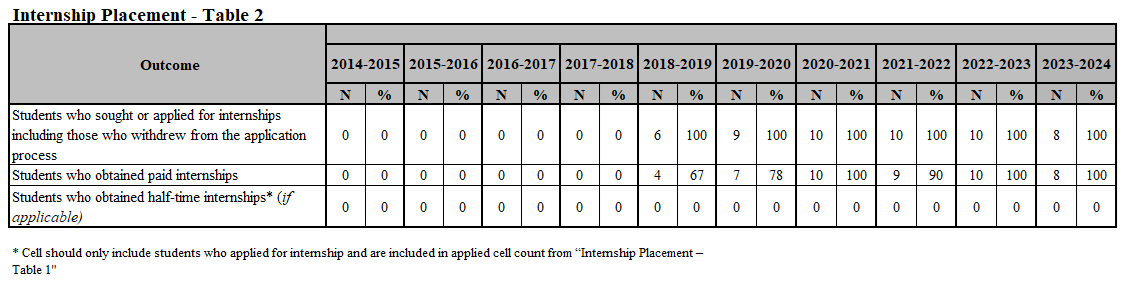
Partial Summary Statistics 2020-21 Internship

OutcomeNumber of StudentsPercent
Students who sought or applied for internships9100%
Students who obtained internships9100%
Students who obtained paid internships777%
Students who obtained APA/CPA accredited internships555%
Students who obtained other internships that were not APA/CPA-accredited445%

Accreditation

The PsyD and MS School Psychology programs are approved by The New York State Board of Regents and fully accredited by the National Association of School Psychologists (NASP) through August, 2030.

Masters in School Psychology Program Annual Report and Student Outcomes Data https://apps.nasponline.org/standards-and-certification/graduate-education/index.aspx?id=958221

Additionally the PsyD program is fully accredited by the American Psychological Association (APA) through November, 2033.

https://accreditation.apa.org/contact

apaaccred@apa.org

Office of Program Consultation and Accreditation
750 First Street NE
Washington, DC 20002-4242
Telephone: (202) 336-5979
TDD/TTY: (202) 336-6123
Fax: (202) 336-5978

We are also currently a Doctoral Program Associate (DPA) member of the Association of Psychology Postdoctoral & Internship Centers (AAPIC).

Roberts Wesleyan University is accredited by the Middle States Association of Colleges and Schools, and is a member of the Association of Colleges and Universities of the State of New York, Rochester Area Colleges, Rochester Regional Library Council, the Association of Free Methodist Educational Institutions, the Council of Independent Colleges and Universities, and the Coalition of Christian Colleges and Universities.

Want more information about this program?

Download a program guide with detailed information on cost, courses, and outcomes

Loading...

Meet Your Admissions Counselor

Laurie Couch
Assistant Director of Recruiting & Admissions

Student Admissions, Outcomes, and Other Data

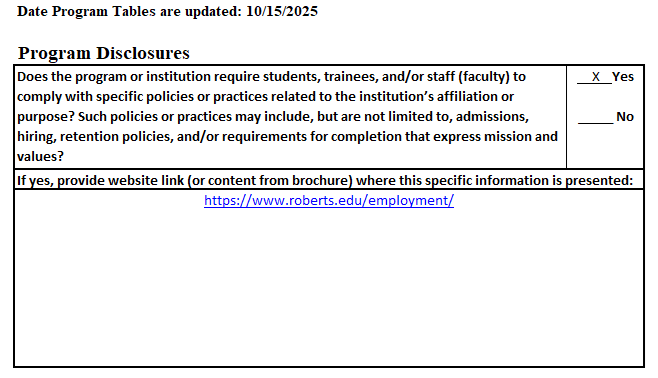
PsyD Program Disclosures 2025

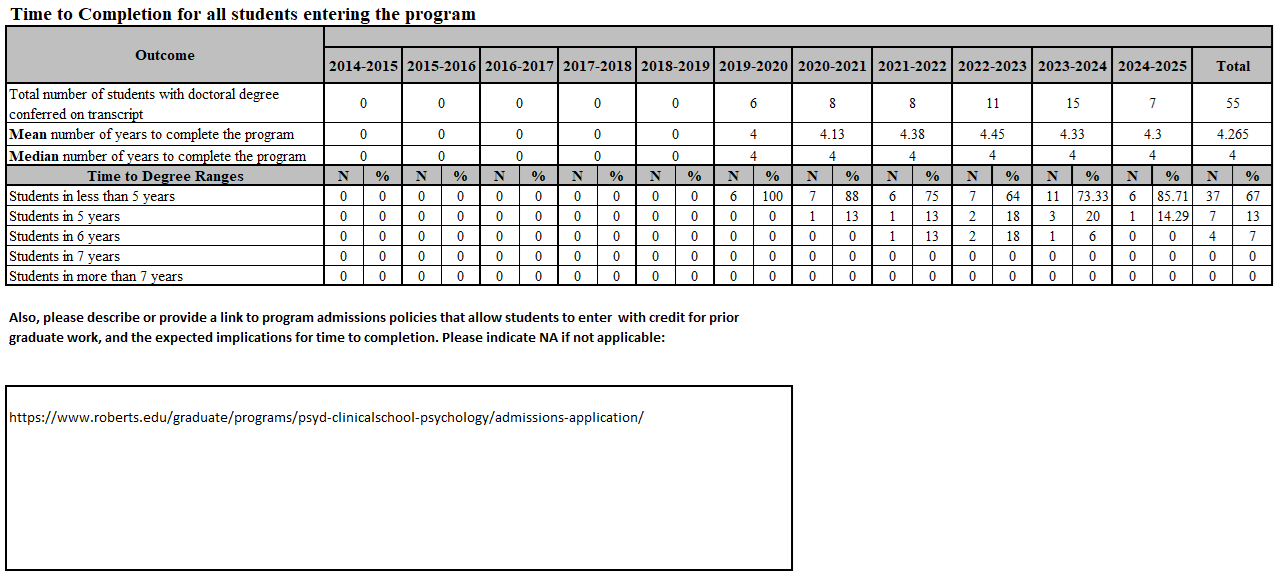
PsyD Time to Completion 2025

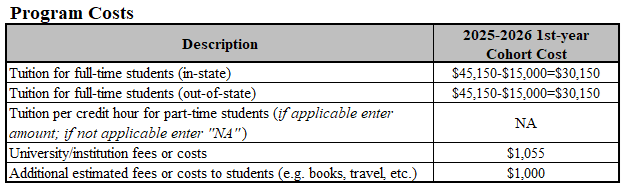
PsyD Program Costs 2025

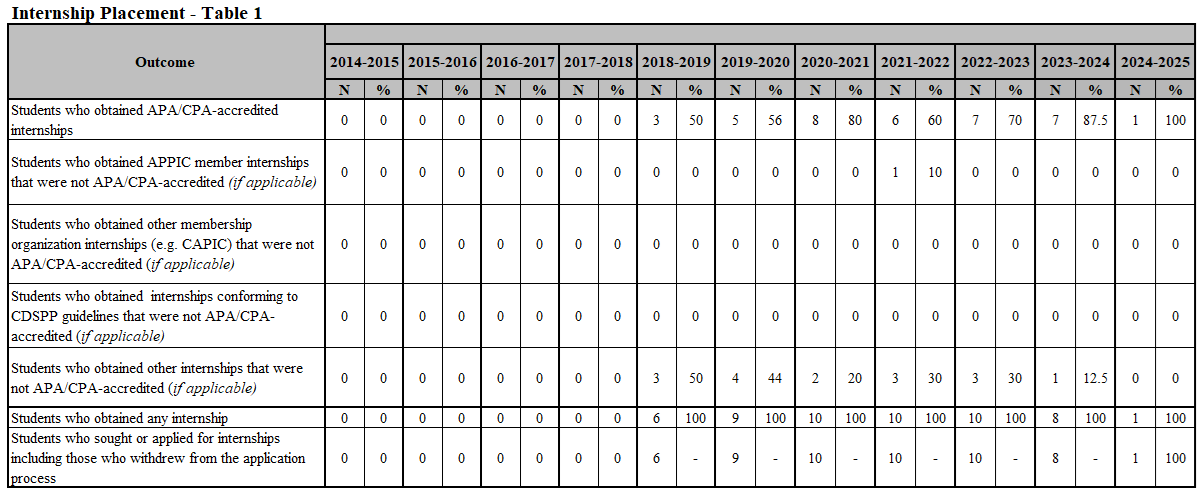
PsyD Internship Placement 2025

PsyD Internship Placement 2025

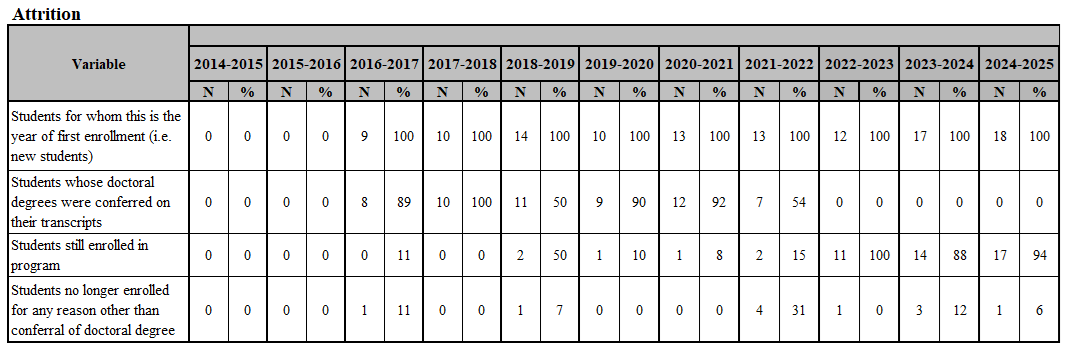
PsyD Attrition 2025

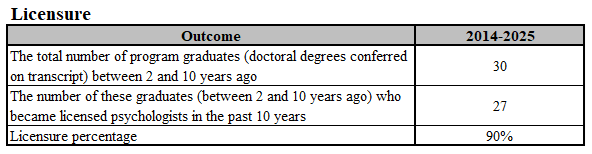
PsyD Licensure 2025